

Dr. Gabriele Casirati
In a recent Nature publication, Dr. Gabriele Casirati, Dr. Andrea Cosentino, and colleagues in the Genovese Lab at the Dana-Farber Cancer Institute, Boston Children’s Hospital, and Harvard Medical School described an alternative to chemotherapy and radiation conditioning to enable hematopoietic stem cell transplantation. They used base and prime editing to edit KIT receptors in cells for transplantation that will allow for the use of KIT-targeting antibodies, which is an alternative way to clear cancerous cells in the bone marrow niche and create space for engineered cells to be transplanted. Dr. Gabriele Casirati, co-first author of the study, sat down with Science in Boston to discuss the research.
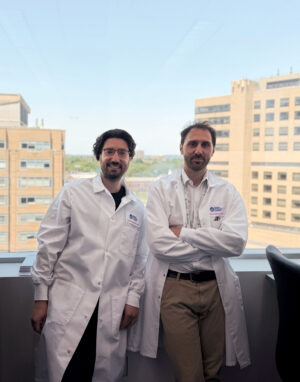
Drs. Andrea Cosentino and Gabriele Casirati
Can you provide a brief overview of your lab’s current research focus?
My current research at Boston Children’s Hospital and Harvard Medical School sits at the intersection of genome engineering, hematopoietic stem cell biology, and cellular immunotherapy. We develop technologies that alter how therapeutic agents recognize healthy and malignant cells, devise new approaches to replace and engineer cells within the body, and refine genome editing technologies to enhance safety and efficacy. One example is epitope editing, in which we introduce minimal changes into cell surface proteins to prevent recognition by a specific antibody or cellular immunotherapy while preserving the protein’s normal biological function.
We have applied this concept to two major problems: protecting healthy hematopoiesis during targeted treatment of blood cancers, and developing safer approaches to hematopoietic stem cell transplantation and gene therapy.
What is the significance of the findings in this publication?
Hematopoietic stem cell transplantation and many stem cell gene therapies still require conditioning with chemotherapy or radiation. While conditioning creates space within the bone marrow niche for the transplanted stem cells, it can also cause severe organ toxicity, infertility, prolonged cytopenias, risk of secondary malignancies, and other serious complications. Antibodies targeting KIT, a receptor expressed by hematopoietic stem and progenitor cells, offer a more selective and safer alternative. However, these antibodies can also deplete transplanted cells that express the same marker after they are infused, meaning that transplantation may have to be delayed until the antibody has cleared.
In this study, we used base editing and prime editing to introduce precise amino-acid substitutions into the KIT extracellular domain. These changes prevented recognition by anti-KIT inhibitory antibodies while preserving KIT expression and stem cell factor signaling. The edited cells could therefore be transplanted during antibody conditioning and could continue to resist subsequent antibody treatment.
We also combined KIT epitope editing with therapeutic editing of the BCL11A erythroid enhancer, which de-represses fetal hemoglobin (HbF) expression and is relevant to sickle cell disease and β-thalassaemia. Anti-KIT treatment progressively enriched the cells carrying both edits in vivo, while barcode analysis indicated that this enrichment did not produce clonal skewing within the protected graft.
The broader significance is that conditioning and transplantation no longer have to be treated as two separate steps divided by antibody washout. Epitope editing creates a controllable system in which an immune-based conditioning agent can simultaneously deplete unedited hematopoiesis, spare the therapeutic graft, and enrich successfully engineered cells.
Was there anything particularly challenging that stood out to you or that you had to troubleshoot?
One major challenge was identifying KIT mutations that completely disrupted antibody recognition without compromising the normal function of KIT. KIT is essential for hematopoietic stem cell maintenance, so simply reducing or eliminating its expression was not an acceptable solution. We had to map the antibody epitopes, screen candidate substitutions, and test receptor expression, ligand binding, signaling, proliferation, differentiation, and long-term engraftment.
This was especially important for SR-1, the antibody from which the clinically investigated antibody briquilimab was derived. We found that certain mutations, while being efficiently installed by gene editing, could not fully protect at higher antibody concentrations. We therefore developed a prime editing strategy to install the D121L substitution, which more completely eliminated antibody recognition while preserving stem cell factor binding.
Another challenge was optimizing antibody exposure. In vivo selection depended not only on the cumulative antibody dose but also on the dosing schedule. More prolonged, extended-interval regimens produced stronger enrichment than more dose-dense treatment with the same cumulative dose. This emphasized that biological conditioning is a dynamic process and that pharmacologic scheduling can be as important as the editing strategy itself.
Do you have any tips or advice you’d give other researchers working in this same system?
One important lesson is to approach hematopoietic stem cell and genome engineering as a biological design problem rather than focusing solely on editing efficiency. Stem cells have multiple layers of complexity, and many of their defining properties can be assessed only through functional evaluation. Molecular design must therefore be integrated with rigorous ex vivo and in vivo testing to establish both safety and therapeutic efficacy.
It is equally important not to be constrained by prevailing paradigms. Challenging established models and reconsidering widely accepted assumptions can be essential to generating truly innovative findings and translating them into clinically meaningful strategies. Finally, collaboration across disciplines is particularly important in this field. Bringing together expertise in protein structure, genome editing, stem cell biology, immunology, and translational modeling can substantially accelerate the development of an initial concept into a robust therapeutic platform.
What are the next steps for this research?
An immediate priority is to optimize the components required for clinical translation. This includes improving editor and guide combinations, minimizing bystander and off-target editing, and defining antibody regimens that provide sufficient niche clearance without unnecessarily depleting progenitor populations. Larger and more immunologically complete models will also be needed to evaluate dosing, long-term safety, and the potential for immune responses against the edited epitopes.
We are also interested in testing this strategy in additional diseases. Hemoglobinopathies provide a compelling initial application, but inborn errors of immunity, bone marrow failure syndromes, metabolic disorders, and other conditions in which partial correction or mixed chimerism is beneficial may also be suitable.
More broadly, epitope editing is modular. It could be extended to other hematopoietic surface targets and combined with antibodies, antibody-drug conjugates, bispecific antibodies, or CAR-T cells. These combinations could potentially eliminate both diseased hematopoiesis and malignant cells while protecting the replacement graft. A particularly appealing longer-term direction is to combine epitope editing with direct in vivo delivery of genome editors. In that setting, even if only a fraction of stem cells were initially edited, subsequent immune-mediated selection could progressively enrich the therapeutically modified cells inside the patient.
 Funding Sources
This work has received support from the American Society of Transplantation and Cellular Therapy New Investigator Award, the DKMS John Hansen Research Grant, the American Society for Gene and Cell Therapy Career Development Award, and the Pediatric Transplantation and Cellular Therapy Consortium–Jeff Gordon Children’s Foundation New Investigator Award.